3 posts tagged with "oi-kit"

Building agents with oi-kit.

View All Tags

Same Brain, Different Bill

· 3 min read
Filip Kujawa
Software Engineer

Coding benchmarks are mostly about which frontier model solves the most tasks. Now that tokens are no longer free, what it costs to solve them matters just as much. Between the model and the bill sits the harness, which decides what goes into each request and how many requests a task takes.

To see how much that layer matters, we gave five open harnesses (goose, Codex CLI, OpenCode, Hermes Agent and pi) the same model, gpt-6.1-sol at high reasoning effort, and the same Terminal-Bench 4 tasks. Each harness attempted every task five times, for 310 scored trials per harness.

Results​

goose matched Codex CLI, OpenCode and Hermes Agent on pass rate. Its cost per task was 15 to 43% lower. pi tied goose on both.
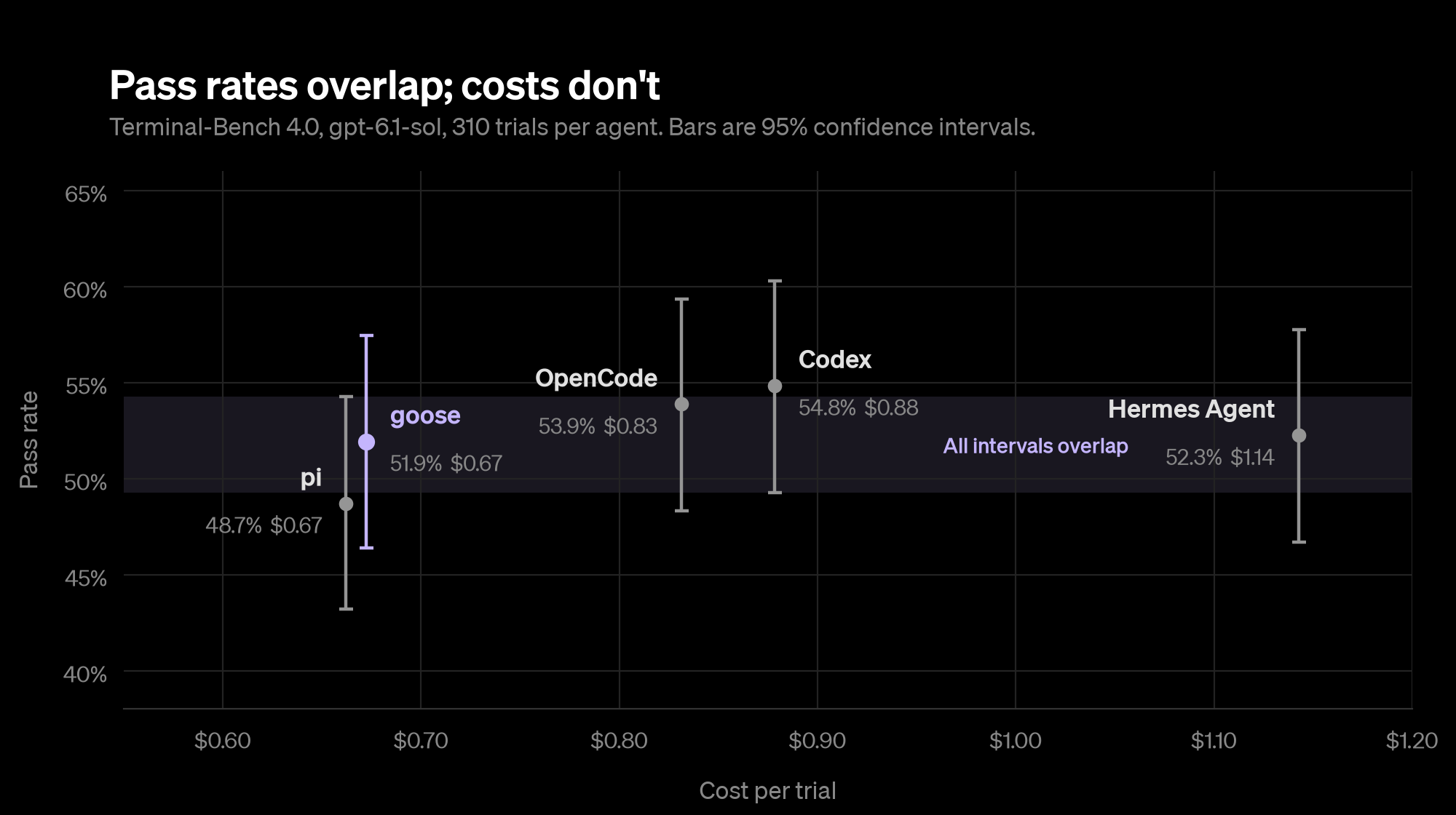

Scatter plot of pass rate against cost per trial for five agent harnesses on Terminal-Bench 4.0 with gpt-6.1-sol. All pass-rate confidence intervals overlap between roughly 49% and 54%, while cost ranges from $0.67 for goose and pi to $1.14 for Hermes Agent.

Agentic State Machines

· 6 min read
Douwe Osinga
Software Engineer

A goose walking from a tangled agent loop into an orderly sequence of machines

goose launched a long time ago. Dog years have nothing on Agent years. goose predates general agentic AI by a bit. The initial thought behind it all was: what happens if you give an LLM control over a shell session?

Turns out interesting things happen. The model writes a command, the command runs, the result goes back into the conversation and the model decides what to do next. Our tool calling grew naturally out of that experiment, as did the agent loop that now sits at the heart of most coding agents.

Then tool calling got formalized and MCP happened. So did approvals, context management, todo lists, top-of-mind, subagents, retries, hooks, skills, recipes and steering. But the original agent loop remained. Each feature added another branch, another local variable or another special case. A dozen different concerns might be active inside one turn, each influencing the others. Cancellation needs to know whether inference or a tool is running. Compaction needs to understand provider errors and usage. Tools can change the prompt. A stop hook can turn a completed answer back into more work. The loop started to turn into spaghetti.

How to Break Up with Your Agent

· 6 min read
Adrian Cole
Open Source Contributor

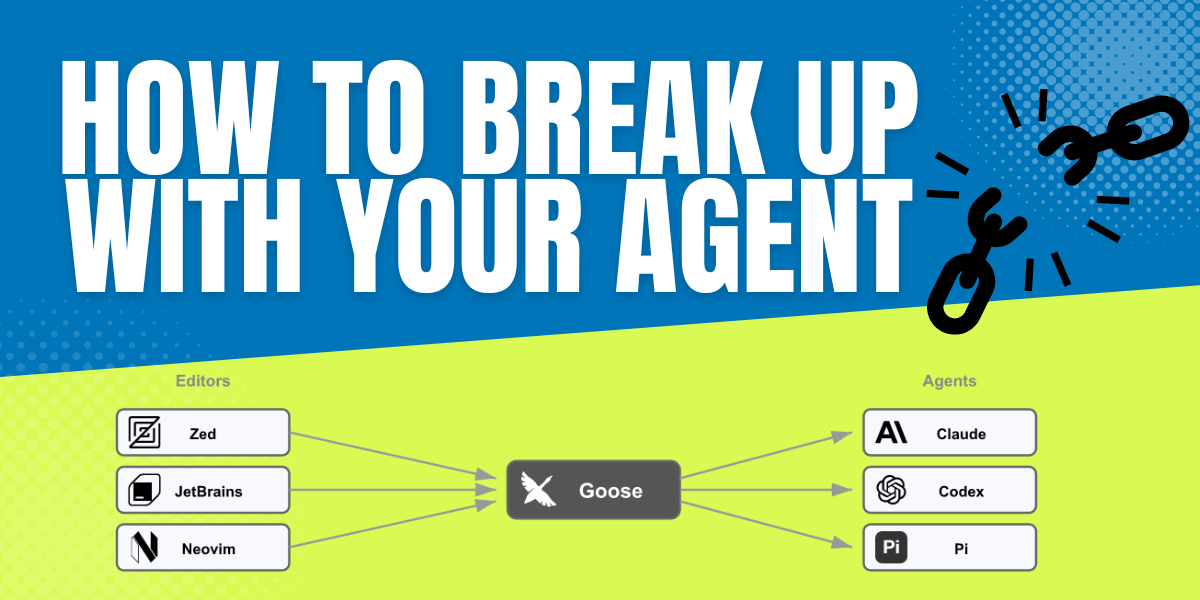
Editors connect to Goose via ACP, and Goose connects to multiple agents

The biggest shift in developer tooling over the last year wasn't the rise of agents. It was the rise of agent subscriptions. We stopped choosing LLM platforms and counting tokens. We started choosing an agent CLI and paying a flat monthly fee.

That works until you realize each agent implies a specific frontend. Cursor is its own editor (a VS Code fork). Claude Code started as a terminal-only tool. Many agents only work well inside one specific environment. Even agents with broad IDE support, like Copilot, tie deeper features to their own ecosystem. If you want a different agent in your favorite editor, you're often out of luck.

Agent Client Protocol (ACP) is a community specification led by Zed Industries that decouples agents from editors. Goose implements ACP in both directions: editors can plug into goose, and goose can plug into other agents. This post walks through what that looks like in practice today.